THE AI UPDATE / ANGELO ROBLES
Updated
The frontier moved.
Build with it.
Better models are only the beginning. Personal agents carry work across sessions. AI builds software. Experts are using it to attack harder research problems. The office has to change what it assigns—and what it expects to accomplish.
Five developments. What they change for a family office. Open any section for the detail and sources.
01FRONTIER MODELSMake every model earn its role.Claude, GPT, and Gemini keep moving. Build an office that can move with them.
November’s releases include Claude Fable 5.2, GPT-6.2 Astra and Sol, and Gemini 4 Carbon, Hydrogen, and Neon. The choices for reasoning, coding, research, and agent execution continue to change. A model’s reputation is a starting point. Its performance on your work decides its role.
Google belongs in the build. Its Gemini stack extends from models to Gemini Notebook for research grounded in selected sources, and Antigravity for coding and coordinated agents. Evaluate the working system: the model, the tools it can use, and the evidence it returns.
For the office: Test candidates against a completed investment memo, a diligence case, or a recurring operating task. Examine errors, evidence, completion time, and the effort required to check the work. Keep the family’s accepted knowledge and methods portable as the model roster changes.
02PERSONAL AGENTSGive an agent a responsibility.An agent can retain context, use tools, and continue an assignment beyond a single conversation.
Products such as OpenAI’s dots and Meta’s Muse make the shift visible: personal agents with continuing context and working environments that can carry an assignment forward across sessions. The consequential change is the move from isolated answers to work that continues.
Give an agent a defined responsibility: maintain a research watchlist, organize incoming diligence questions, or prepare a recurring briefing from approved sources. Establish what it may read, change, or send, what it must bring back for review, and who in the office owns the result.
For the office: Start with one consequential, recurring job. Inspect the agent’s retained context and completed work. Expand its authority as its reliability earns it. Measure whether the responsible person can decide and execute better.
03LOCAL & OWNED INTELLIGENCEBring intelligence under your control.Inkling 2 Mini adds an American open-weight option. The hardware and the operating design matter.
U.S.-based Thinking Machines Lab released Inkling 2 Mini on November 20 under Apache 2.0. It has 26.4 billion parameters, with approximately 3.4 billion active per token. The publisher’s low-bit checkpoint is approximately 20GB.
The supported Mac configuration is Apple silicon with 32GB or more memory. For other GPU platforms, the publisher recommends 32GB or more of VRAM. Match the deployment to the actual machine and workload before making local AI part of the office’s operating design.
For the office: Examine which work should run on infrastructure the family controls. Control includes the knowledge store, tool permissions, logs, updates, and what information can leave. Test the entire workflow and retain a responsible human owner.
04CUSTOM TOOLS & COORDINATED AGENTSBuild the tools. Keep the method.Turn recurring work into software and reusable AI skills that reflect how your office actually operates.
AI coding systems and coordinated agents expand what a small team can build. A research interface, a diligence workflow, or a financial dashboard can be designed around the office’s own questions, definitions, and review process.
An AI skill is a reusable working method: instructions, reference material, tools, and checks for a specific job. A coordinated team of agents divides the work into defined responsibilities. Give each agent a clear assignment and require evidence that another person or system can inspect.
Use independent review to challenge a thesis. Use coordination to execute a shared task. More agents require a clearer design for who does what, how disagreements are handled, and when a human takes over.
For the office: Examine which software subscriptions earn their place and which recurring tasks warrant an owned tool. Count maintenance, security, data quality, and verification in the economics. In the masterclass, members build and test these methods with practitioner faculty.
Explore the hands-on masterclass05THE RESEARCH FRONTIERRevisit what you assumed was out of reach.The Riemann Hypothesis puts human–AI research and rigorous verification in the same frame.
The Riemann Hypothesis is a central mathematical problem about the distribution of prime numbers. On November 20, mathematician Levent Alpöge announced a proof developed with Claude. On November 21, the Lean FRO and Mathlib Initiative reported successful verification of the formal statement and proof. Independent verification results are also published by MIT’s Andrew Sutherland.
The work of explaining the mathematical ideas continues. The combination matters: expert direction, AI exploration, and explicit verification of the result.
The implication for the office: Revisit difficult research, analysis, and engineering problems whose cost once kept them off the agenda. Pair the relevant expertise with AI and a credible way to check the work. Yesterday’s limits deserve a fresh examination.
MEMBERS ONLY / TWO EVOLVING AI BOOKS
The deeper work.
Revised as the frontier moves.
Angelo revises both member editions approximately every 30 days. The public update identifies the shifts. The books develop the methods, decisions, and institutional design behind the work.
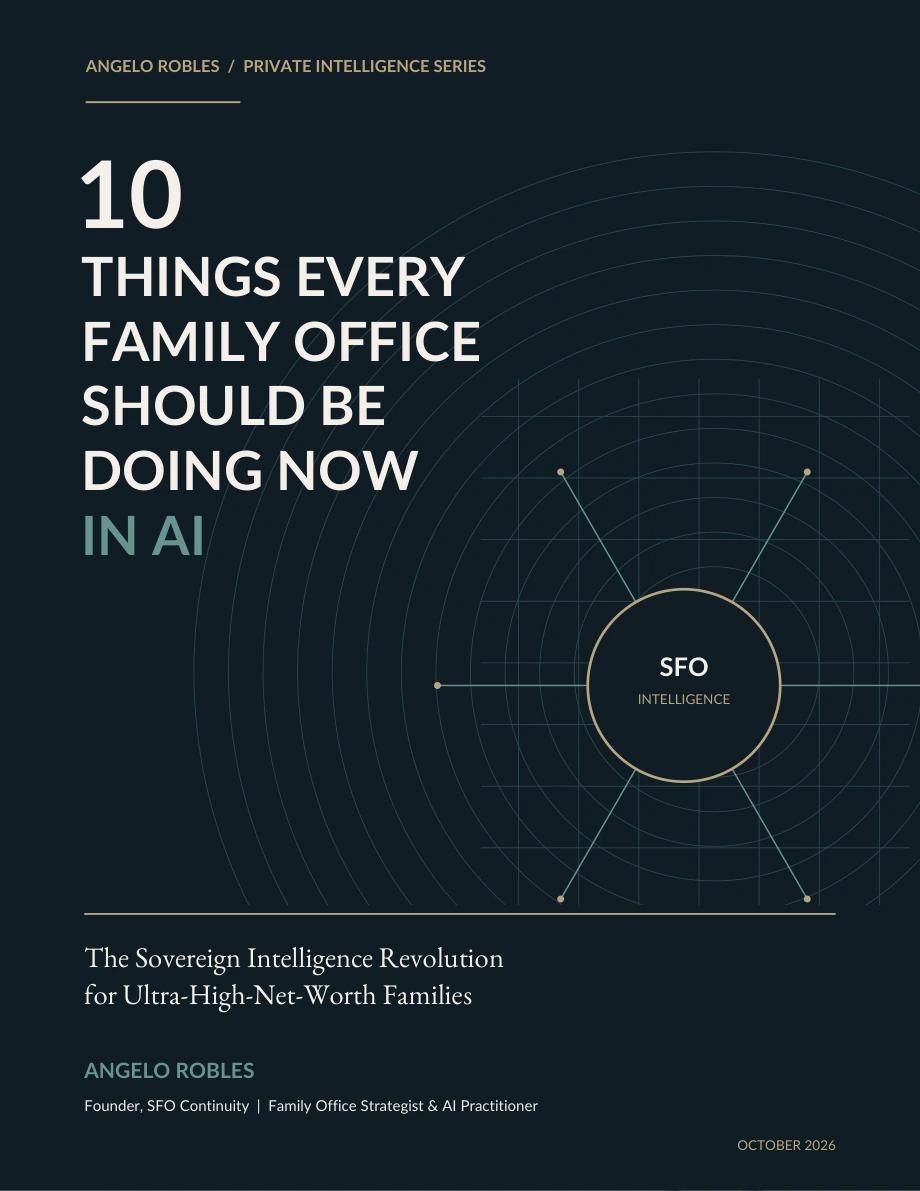
10 Things Every Family Office Should Be Doing Now in AI
What to test, connect, build, and run. Prompting, models, agents, reusable skills, and practical work the office can put into operation.
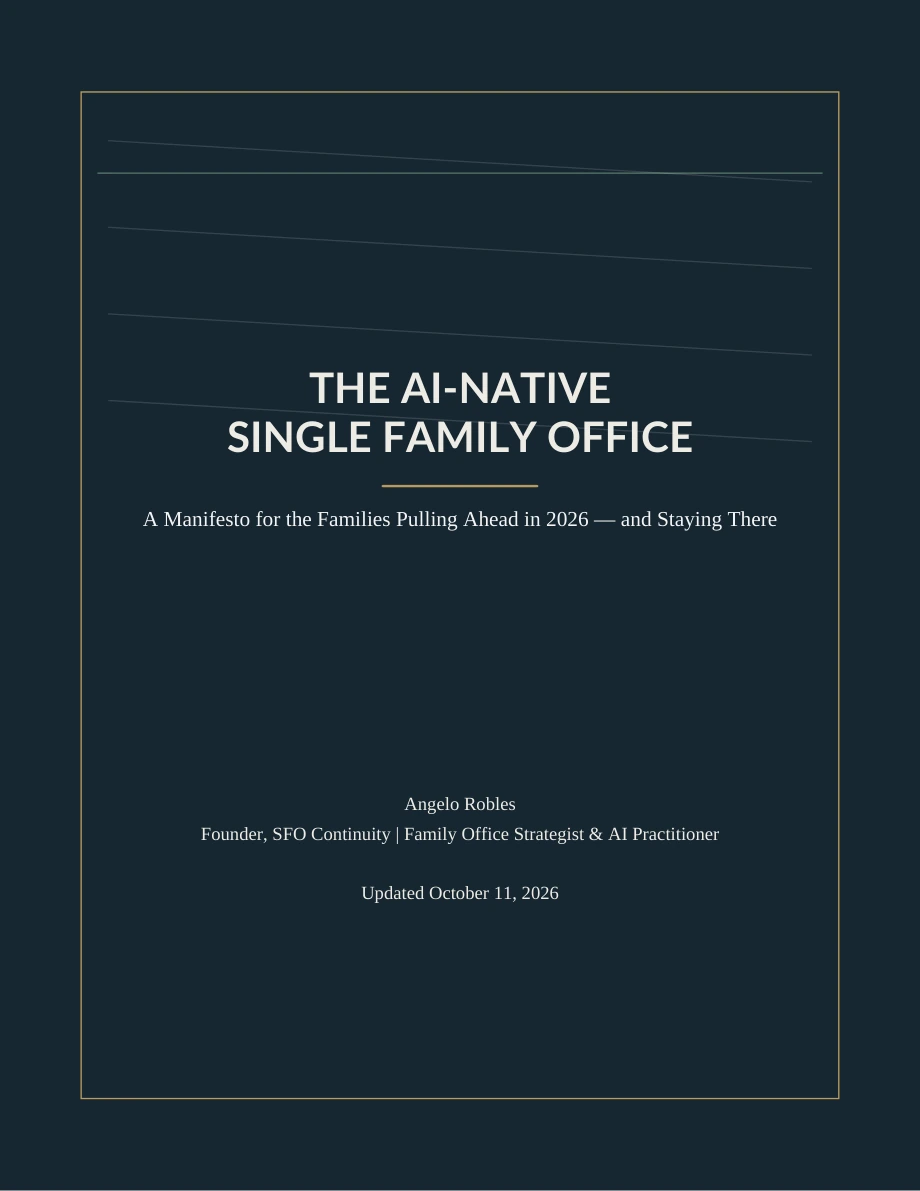
The AI-Native Single Family Office
What the family owns, who may act, and how judgment survives. Authority, people, retained knowledge, continuity, and the next generation.
Both books are included in SFO Continuity’s $10,000 annual membership, alongside the four in-person AI masterclasses, private forums, and direct exchange with Angelo and peers.
Explore SFO Continuity